by Tim Saunders – Head of AI & Technology
The thing most people misunderstand about AI and operational systems
AI language models are probabilistic systems. The same prompt can produce slightly different outputs across runs, especially when the task involves interpretation or open-ended reasoning.
That is not to suggest that AI is unreliable. In fact, variation can be a bonus in the right circumstances.
Humans are non-deterministic too. Ask two project managers to summarise the same set of risks and you may get different but equally reasonable answers. It is a question of context.
For exploratory or interpretive work, variation is often acceptable. For operational workflows, such as bulk updates, approvals, compliance checks, and recurring reporting, repeatability and auditability matter far more.
That distinction matters because many Smartsheet workflows are fundamentally deterministic. If you already know the rule, the strongest solution is usually the one that encodes the rule explicitly.
The important question therefore is: “Is this a task where uncertainty is acceptable or warranted?”

What already does this better
Before reaching for AI, it is worth asking whether the job really suits its specialisms, or whether there is already a tool that solves the problem more reliably.
Recurring reports and dashboards
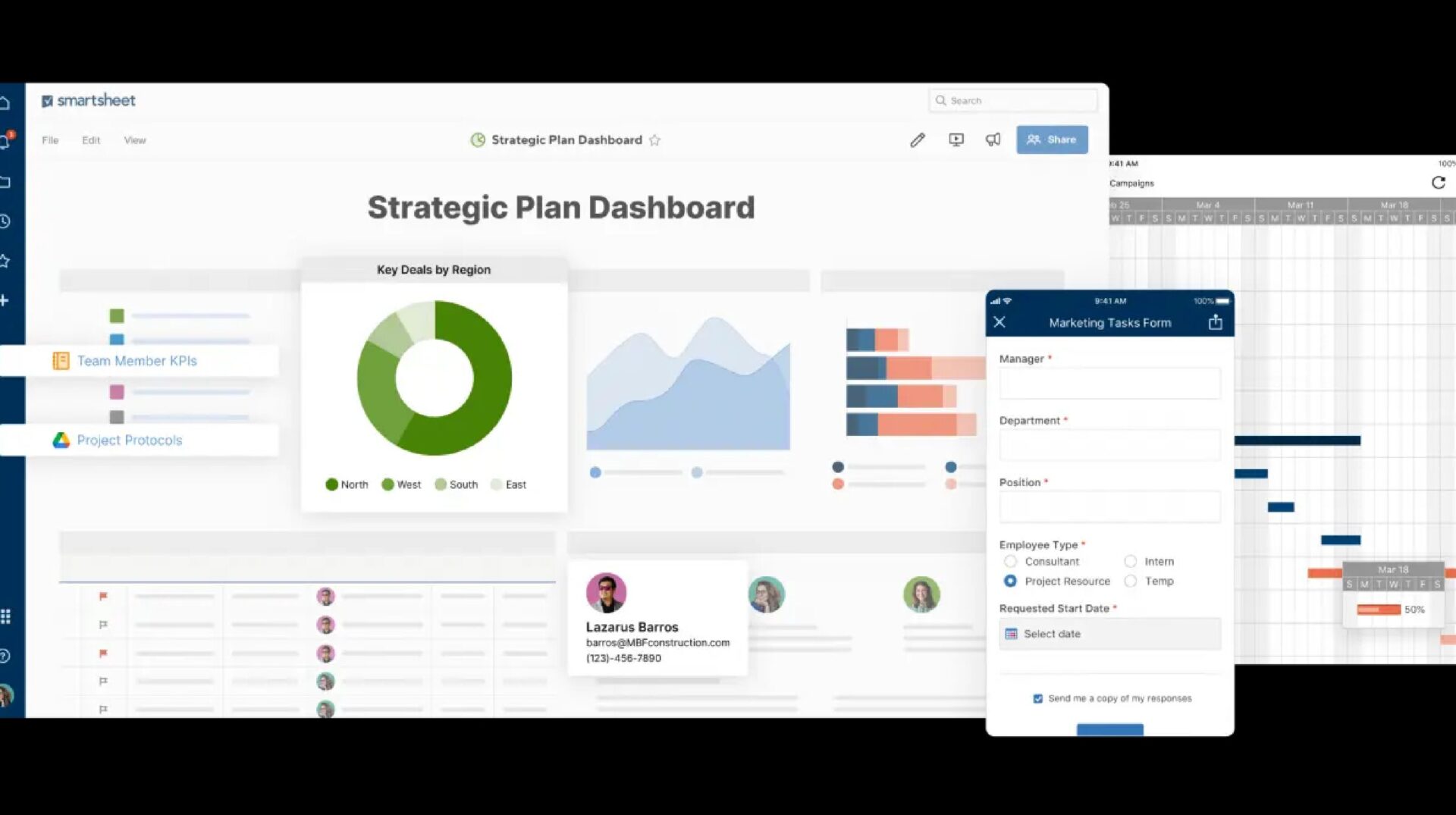
If leadership needs the same operational view every week, build a report or dashboard. Smartsheet reports and dashboards are always current, shareable, auditable, and require no one to remember to run a prompt. Running a prompt over a collection of dashboards might yield new insights, but using AI to repeatedly generate a weekly status summary creates an unnecessary dependency on conversational interaction for a problem that may already have a stronger native solution.
Bulk data changes
If you need to update 50 rows according to a clearly defined rule, reassign tasks, update statuses, or shift dates, the strongest answer is usually deterministic automation or a script. Scripts and automations are repeatable, reviewable, version-controllable, auditable, and predictable. Natural-language instructions are inherently more ambiguous, and while that ambiguity can be useful when suggesting changes, it is less attractive when directly applying them.
Data quality enforcement
If the goal is enforcing known rules, use known rules. Missing owners, invalid status values, overdue tasks, dependency violations: these are often better handled with formulas, validation logic, conditional formatting, or automations. If you find yourself repeatedly asking AI to detect the same structured issue, that is usually a sign the logic should be operationalised elsewhere.
Where AI potentially adds value
AI becomes useful when the problem is interpretive rather than deterministic.
Exploratory questions you did not anticipate
A dashboard answers the questions you knew to ask. AI can help with questions you did not explicitly model. Why are multiple projects slipping at once? What themes appear across blocked work? What do discussion threads suggest that status columns do not?
Synthesis across multiple sources
Reading five sheets and summarising the patterns manually takes time. AI can help synthesise across multiple sheets, discussion history, comments, unstructured notes, and portfolio-level operational context.
Semantic interpretation
Some tasks are not naturally deterministic. Identifying comments that imply escalation risk, categorising free-text updates by theme, or detecting urgency in qualitative data are areas where traditional formulas struggle and AI is often the best available tool.

Where AI can become risky
One of the riskier patterns is an unconstrained AI acting as an operational decision-maker. Instructions such as “update all delayed projects” or “clean up inconsistent statuses” sound simple but hide ambiguity. What counts as a delay? What makes a status inconsistent?
The official Smartsheet MCP documentation describes staging patterns such as testing on a single row first, dry-run confirmation, and version checks before and after writes. These are sensible safeguards, and in write operations they are critical, but they are not guarantees of correctness.
In Short
AI connected to Smartsheet is neither a gimmick nor a general-purpose replacement for operational tooling. It is strongest when the work involves interpretation, synthesis, exploration, semantic understanding, or natural-language interaction. It is weaker when the work involves deterministic rule execution, governance enforcement, or exact bulk changes.
Knowing where that line sits is where the real skill lies, and where working with an experienced Smartsheet partner makes the difference.